
Policy Beyond Politics
Discussions and interviews with guests who are eminent policy researchers and practitioners on contemporary public policy issues (widely debated or conveniently missed), curated by the Centre for Public Policy Research (CPPR). CPPR, based in Kochi (Kerala, India), is an independent, public policy think-tank dedicated to in-depth research and scientific analysis with the objective of delivering actionable ideas to transform society.
Episodes

Ep 72| Beyond the Statutes: Strengthening the Pillars of Women’s Safety in India
This episode examines the institutional ecosystem that shapes women’s safety in India beyond the existence of legal statutes. Over the past two decades, the country has introduced an extensive legal framework addressing domestic violence, sexual offences, trafficking, and workplace discrimination. Yet, persistent gaps remain between statutory guarantees and the realities experienced by women, part
EP 71| Gender Budgeting – International Perspectives
This podcast examines whether fiscal systems, particularly tax structures, have mitigated or reinforced gender inequities over the past three decades. While gender budgeting has gained global policy visibility, empirical evidence suggests that fiscal frameworks often remain formally gender neutral yet substantively unequal in impact. The discussion interrogates how income taxation, consumption tax
EP 70 | The Rules of the Game: Constitutions and Public Accountability
The fifth episode of the five-part podcast series on the book, Public Choice – A Primer by Dr Eamonn Butler, explores how constitutions function as the foundational rules that shape governance and public accountability. It examines why societies need constitutions beyond symbolism, and how constitutional frameworks influence political decision-making and limit government excesses.Drawing from the
EP 69 | Rethinking Public Choice: Lessons and Future Horizons
The fourth episode of the five-part podcast series on the book, "Public Choice – A Primer" by Dr Eamonn Butler, explores brings together key insights from Public Choice: A Primer and reflects on how the theory continues to evolve in response to new governance challenges.Based primarily on Chapter 12 (Current and Future Horizons), the discussion revisits earlier themes, the logic of colle
EP 68 | Power, Interest, and Incentives in Politics
The third episode of the five-part podcast series on the book, "Public Choice – A Primer" by Dr Eamonn Butler, explores how incentives drive political and bureaucratic behaviour, why collective decisions are vulnerable to special interest influence, and how institutional design, as explained by Public Choice Theory, can either mitigate or amplify these distortions.Drawing from Chapters 5
EP 67 | Decoding India’s Fiscal Landscape: The 15th Finance Commission Years
As India stands on the brink of the XVI Finance Commission’s recommendations, the debate on fiscal federalism has re-emerged at the centre of public policy discourse.A recent report titled “State Finances in Transition: An Analysis of Revenue Receipts and Fiscal Dynamics in India during the XV Finance Commission Period,” published by the Foundation for Responsive Governance and authored by Sharad
EP 66 | Government, Elections and the Voter’s Paradox
The second episode of the five-part podcast series on the book, "Public Choice – A Primer" by Dr Eamonn Butler, explores how and why governments exist, how collective decisions are made, and how electoral behaviour shapes policy outcomes.Drawing from the chapters “Who Needs Government?” and “How to Win Elections,” the episode attempts to unpack the mechanisms of governance, the trade-off
EP 65 | Public Choice Theory - An Introduction
Public policy shapes our lives, but how these decisions are made is often misunderstood.This CPPR podcast—the first of our five-part series on the book, "Public Choice – A Primer" by Dr Eamonn Butler—introduces our audience to Public Choice Theory.Public Choice applies economics to politics, showing how voters, politicians, and bureaucrats act in self-interest—just like in markets. In th
EP 64 | Prospects and Pressures of Low-Fee Private Schools in India
Private schools educate nearly one-third of India’s students, with Low-Fee Private Schools (LFPS) serving the majority from low and middle-income families.Despite their vital role, LFPS struggle under rigid regulations—land and infrastructure mandates, fee caps, and burdensome recognition processes—that prioritize compliance over learning.This podcast explores why parents choose LFPS, how state re
EP 63 | The Hidden Side of Manufacturing: Inside India’s Strategy of Multi-Plants
India’s manufacturing sector, despite liberalization and decades of economic reforms, continues to underperform relative to its potential.A recent study, “Multiplying Multi-Plants: A New and Consequential Phenomenon” by Arvind Subramanian, Abhishek Anand, and Dr Naveen Joseph Thomas, sheds light on a critical yet overlooked factor influencing this stagnation—the rise of multi-plants.These are mult
EP 62 | Sports Beyond Medals - Part 1 | Policy Beyond Politics
India’s sports industry is booming, with leagues like the Indian Premier League (IPL) and Indian Super League (ISL) contributing billions to the economy. The IPL alone is valued at $16.4 billion in 2024, with other leagues following suit.
However, despite this growth, sports participation at the grassroots level remains limited, especially outside of cricket.
Moreover, sports in India is often v
EP 61 | Building a Senior Citizen Friendly Kerala: Challenges and Innovations | Policy Beyond Politics
Kerala has a rapidly ageing population, with the proportion of senior citizens (aged 60 and above) projected to reach 22.8% by 2036, significantly higher than the national average of 15%. This demographic shift poses challenges for the state in terms of providing adequate care and support for its elderly population. As Kerala grapples with the challenges of a rapidly ageing population, a compreh
EP 60 | Business Regulations: Decriminalisation, Simplification and Digitisation | Policy Beyond Politics
In this episode, we explore the need for decriminalisation, simplification, and digitisation in business regulations. We dissect the implications of the Jan Vishwas Act and proposed amendments and delve into the progress of decriminalisation across the nation, identifying states leading the charge in reform efforts. Join us as we unravel the complexities and envision the future of business regulat
EP 59 | Insights into Change: Recent Trends in India’s Female Labour Force Participation | Policy Beyond Politics
In the 2023 annual Gender Gap Report by the World Economic Forum (WEF), India saw an advancement in its ranking, now positioned at 127 out of 146 countries, marking an improvement of eight places compared to the previous year. However, the report emphasised that India’s attainment of only 36.7% parity in economic participation and opportunity underscores the ongoing challenge of addressing gende
EP 58 | What do ChatGPT and AI look like in India today? | Polict Beyond Politics
Generative AI is projected to increase annual global GDP to the amount of trillions if implemented properly, according to analysts. What is India’s stake in this new global phenomenon? In today's podcast, we look at generative AI and LLMs, the issues they pose, the effect they have on Indian society and industry, and how we can look forward to regulating AI while allowing it to grow and prov
EP 57 | Breaking Business Barriers in Kerala: Decriminalisation of Business Laws | #PolicyBeyondPolitics
In this podcast, we will be diving into the topic 'Decriminalisation of business laws in the state of Kerala'. Kerala, with a Gross State Domestic Product of 7.8 lakh crore, has shown promising growth potential. However, it currently ranks 15th in the Ease of Doing Business ranking within the country, indicating room for improvement in terms of business friendliness. Establishing a favorab
EP 56 | India’s Transition to Non-Motorised Transport | #PolicyBeyondPolitics
To achieve the sustainability goals of the transport sector, it is necessary to promote the use of NMT. In this podcast, Mr Shrinivas Deshmukh, Co-founder & Director, Urban Research Foundation, talks about policy-level and implementation-level challenges in the integration of NMT with the public transport sector. Non-motorised transport systems have been proposed to be seamlessly integrated wi
EP 55 | Will the private sector benefit from the Indian space policy? | #PolicyBeyondPolitics
In this episode of Policy Beyond Politics, we delve into the Indian Space Policy and its implications for the booming space relations between India and the US. With India aiming to increase its share of the global space economy to more than 10% by 2030, we explore the recent milestones in the Indian space sector, including the successful launch of India's first private rocket. We also discuss
EP 54 | Participatory Planning in Public Transport | #PolicyBeyondPolitics
The involvement and participation of citizens and stakeholders in the sustainable urban mobility planning process is necessary in order to obtain public legitimacy and create a plan that satisfies the mobility needs of people. With the adoption of new Information and Communication Technologies (ICT), citizen participation methods have started to shift more towards online environments. Planning for
EP 53 | The NATO Vilnius Summit 2023: Charting the Path Ahead | #PolicyBeyondPolitics
The momentous NATO Summit held in Vilnius, Lithuania this year also known as the summit for implementation, resulted in a comprehensive 90-point joint communiqué. With a wealth of significant announcements, it is essential to analyze the major achievements as well as the unfulfilled promises of the Vilnius Summit, especially as NATO approaches its 75th anniversary in 2024. This podcast episode fea
EP 52 | Contracting and Tendering in the Public Transport System | #PolicyBeyondPolitics
Contracts are an essential tool for any Public Transport Authority. Countries across the globe have incorporated the private contractors into the Public Transport Ecosystem. However, contracting and tendering processes come with possible challenges and implications. In this podcast, Ms Stéphanie, Mobility and Urban Planning Consultant Ubiquity Consulting, Madrid, Spain and Lizbeth Jibi Godwin, Ass
EP 51 | Shaping Regional Security and Cooperation: An Analysis of the 2023 SCO Summit | #PolicyBeyondPolitics
India hosted the Shanghai Cooperation Organization (SCO) Summit 2023 virtually on the 4th of July, 2023, which brought together leaders from member countries such as China, Pakistan, Russia, and more. The primary focus of the meeting was to discuss key issues related to regional security, economic connectivity, and trade. India's hosting of the 2023 SCO Summit marks a significant milestone for
EP 50 | India-US Relations: Reflecting on Modi's State Visit and Beyond | #PolicyBeyondPolitics
Indian Prime Minister Narendra Modi concluded a four-day official trip to the United States on 23 June 2023. Apart from receiving an elaborate welcome ceremony and attending a state dinner, Modi was also granted the opportunity to deliver a speech to Congress for the second time during his tenure as Prime Minister. These significant occasions aimed to demonstrate the mutual dedication of both nat
EP 49 | From Textbooks to Tech: The Evolution of Classroom Learning | #PolicyBeyondPolitics
In today's fast-paced world of technological progress, Education Technology (EdTech) has gained widespread acceptance and holds immense potential for revolutionising both learning and teaching experiences. To explore how the school education system and teacher training programs can effectively utilise EdTech by identifying the challenges and experiences of educators, teachers, and parents, the
EP 48- Erdogan's Third Decade and its Global Implications | #PolicyBeyondPolitics
President Recep Tayyip Erdogan has been re-elected and sworn in as the president of Turkey for the third time with a vote share of 52.14% against 47.86 % by Mr Kemal Kilicdaroglu. This extends President Erdogan’s 20-year regime up until 2028, into his third decade in power. High hopes were placed on the opposition leader Mr Kilichdarolu who had the potential to unify various political factions in
EP 47 | Clean Mobility - A pledge to a Greener Future | #PolicyBeyondPolitics
Mahatma Gandhi once said, "The world has enough for everyone's need, but not enough for everyone's greed." Let's make a pledge to a greener future with clean mobility. As we mark World Environment Day, it's time to shift towards cleaner energy in mobility.
Did you know that in India, transportation is responsible for 14% of all emissions, with road transport accounting fo
EP 46 | Smart Ports and the Maritime Economy | #PolicybeyondPolitics
This is the episode 46 of #PolicyBeyondPolitics podcast on 'Smart Ports and Maritime Economy'. In this episode, Shilpa S, Associate -Research, CPPR is in conversation with Dr R P Pradhan, Professor, BITS Pilani, Goa.
The International Seaport sector is gearing up with dynamic developments and concepts like Ocean Sustainability and Blue Economy is gaining increased relevance, with many cou
EP 45 | Decoding the Polls : Karnataka Elections 2023 | Part 2 #PolicybeyondPolitics
This episode is a continuation of Decoding the Polls episode recorded in April before the Karnataka elections dawned. The election has been called a celebration of the festival of democracy. The podcast discusses the Karnataka election results and its implication on the state, the two national parties, and the fall of the JDS party. It further discusses the changes in voting patterns and the caste
EP 44 | Kochi Water Metro : Old wine in a new bottle ? | #PolicybeyondPolitics
Kochi's public transportation received a new boost with the introduction of the water Metro. The water metro aims for the development of an integrated water transport system for the city of Kochi. Can the Water Metro solve Kochi's mobility problems?
The podcast discusses Kochi's public transportation and its challenges with a focus on the recently launched water Metro.
EP 43 | Unraveling the India-Japan Partnership from a Geopolitical Lens | #PolicyBeyondPolitics
India and Japan have a long history of friendship and partnership of 1400 years and they continued to be the beneficiaries of partnership from the ancient alliance bolstered by the ideals of democracy, individual liberty, and the rule of the law. The podcast delves into crucial questions around geopolitical, geostrategic, and economic importance with respect to the India-Japan-Indo-Pacific nexus.
EP 42 | Visible Women Invisible Equality Part 4: Easing legal barriers for women in Hospitality Industry | #PolicyBeyondPolitics
Women's economic opportunities are affected by entry level barriers to the tourism and hospitality sector, which is growing in popularity. The Periodic Labour Force Survey 2020-21 estimates the Worker Population Ratio (WPR) on a usual status basis for both males and females aged 15 and above at 73.5% and 31.4%, respectively. The hospitality sector must be gender inclusive for the nation's
EP 41 | Decoding the Polls : Karnataka Elections 2023 | #PolicyBeyondPolitics
The podcast episode on Decoding the Polls: Karnataka Election 2023 discusses the political realities, strategies, and possibilities surrounding the upcoming state election. It deliberates on the challenges that lie ahead for the two national parties, the BJP, and the INC. It also touches upon the JD(S) and its past 'kingmaking' powers. Prof G Gopakumar discusses in depth the relevance of
EP 40 | India-UK Relations and the Emerging Great Power Politics in the Indo-Pacific | #PolicyBeyondPolitics
The podcast discusses the Indo - UK relations in the context of the Indo Pacific and the emerging great power competition in the region .The speaker discusses about the need to look beyond China and the Belt and Road Initiative to bring in regional frameworks that build on regional trade, technological competition, aid and more, which would depict a rise in middle powers within the world order pl
EP 39 | Opportunities for Sri Lanka and it's Recovery | #PolicyBeyondPolitics
The podcast on "Opportunities for Srilanka and it's recovery" discusses the scope of Srilanka's economic recovery through partnership with the Bay of Bengal nations while also discussing the potential of tourism development through blue economy. The podcast also touches upon India - Srilanka relations through people to people connectivity.
Ep 38 | Surveillance Balloons and Security Implications | #PolicyBeyondPolitics
At an age characterised by geopolitical flux and progressing elements of warfare, the case of the Chinese Surveillance balloons sheds light on the fragility of the relationship between Washington and Beijing. The surveillance balloons also echoes a political message from Beijing regarding its capabilities and progress on the international stage. This calls to attention possible future implications
Ep 37 | India's G20 Presidency & Food Security | #PolicyBeyondPolitics
India’s G20 presidency offers a momentous opportunity for the nation to bolster its endeavors in addressing the growing challenges of food security for resilient and equitable food systems. In the context of the recent trends of burgeoning climate insecurities, prolonged global conflicts, rising food prices, and a growing global population, this podcast will examine India's priorities for food sec
Ep 36 | India's Future in Renewable Energy | #PolicyBeyondPolitics
This podcast discussion revolves around the future of India's renewable energy sector and the road map for green energy investment, while also briefly looking into India's strategic competition with other countries in rare earth metals.

Ep 35 Visible Women, Invisible Equality - Part 3 | #PolicyBeyondPolitics
This is Part 3 of #PolicyBeyondPolitics podcast on Visible Women, Invisible Equality. In this episode, Anu Maria Francis from CPPR is in conversation with Mr Tom K Thomas on the practical challenges faced by employers in hiring women employees in factories.
Mr Tom is the former director of Projects and R&D at Ceat Tyres Ltd. He has 45 years of experience in tyre indust
Ep 34 India, Sustainability and the G20 | #PolicyBeyondPolitics
In this Episode 34 of#PolicyBeyondPolitics podcast of the Centre for Public Policy Research, we discuss the topic "India, Sustainability and the G20". Sharon Susan Koshy, Associate Researcher at CPPR talks to Dr. Dhanasree Jayaram and Mr. Govinda Agarwal on the role India plays on the international front to promote sustainability and explore various initiatives the country has taken domestica

Ep 33 Visible Women, Invisible Equality - Part 2 | #PolicyBeyondPolitics
This is Part 2 of #PolicyBeyondPolitics podcast on Visible Women, Invisible Equality. In this episode, Soumya Singh from CPPR is in conversation with Ms Mitali Nikore on the social and cultural barriers faced by women in getting employed in the manufacturing sector, especially in factories.
Ms Mitali is an experienced Economist and Public Policy specialist with a demonstrated history of

Ep 32 Visible Women Invisible Equality - Part 1 | #PolicyBeyondPolitics
In this episode of #PolicyBeyondPolitics, we look at Visible Women Invisible Equality, with Ms April Suzanna Varkey, Associate Researcher at CPPR who will be in conversation with Mr Sreyan Chatterjee exploring the economic and legal challenges faced by women to get employed in the manufacturing sector with a focus on the garments industry.
A lawyer by training, having received his degre

EP 31 The Afghan Question: Examining Great Power Fatigue and the New Asian Geopolitics | #PolicyBeyondPolitics
In this episode of Policy Beyond Politics Sharon Susan Koshy, Associate, Research, CPPR interacts with Dr Stanly Johny, Editor, International Affairs, The Hindu, to discuss Afghanistan and an emergent state of geopolitics in Asia following the Taliban takeover and related events. The conversation draws from Dr Johny's second book "Comrades and Mullahs: China, Afghanistan and the New Asian Geopolit

EP 30 In Conversation with Japanese Consul General Taga Masayuki-san on Avenues of Cooperation in India-Japan relations | #PolicyBeyondPolitics
In this podcast CPPR Associate, Research Sharon Susan Koshy interacts with Japan Consul General Hon. CG TAGA Masayuki-san on Avenues of Cooperation in India-Japan relations. This podcast was recorded on May 26, 2022, during his visit to the CPPR office.

EP 29 Transformational Technologies and U.S. India Science and Technology Cooperation | #PolicyBeyondPolitics
The U.S. and India partnership is founded on an alignment in democratic values, strategic goals, and economic interests. Science & Technology are critical and transformative aspects of this U.S. - India relationship that shapes and accelerates the strategic and economic achievements of both nations. Both countries have repeatedly proven their commitment to cutting edge research and the develop

EP 28 In Conversation with Michael Kugelman on Changing Current in India-U.S. Relations | #PolicyBeyondPolitics
In this podcast CPPR Associate, Research Sharon Susan Koshy interacts with Michael Kugelman on Changing Current in India-U.S. Relations.
This podcast was recorded during our International conference on Indo-U.S Relations change, continuity and transformation.
Mr. Michael Kugelman is the Deputy Director and Senior Associate for South Asia-Wilson Centre, USA.
EP 27 U.S.- India Trade Relations – To the next level | #PolicyBeyondPolitics
The US and India have shared values and interests in promoting global security, stability and economic prosperity through trade investment and connectivity. The cornerstone of US-India partnership remains their trade and commercial linkages. A shared bilateral goal has been the need to realise trade aspirations of USD 500 billion. In 2019, the US goods and service trade in India totaled an estimat

EP 26 United States and India as partners in the Indo-Pacific Region: Reimagining the maritime outlook | #PolicyBeyondPolitics
The Indo-Pacific Region (IPR) is the most contested maritime space in the world today. India and the United States have a critical role to play in forging an open and inclusive Indo-Pacific order. Furthermore, China’s growing influence in the Indo-pacific expanse stands to converge the two countries’ foreign policy strategies in the IPR and presents an opportunity for improved bilateral cooperatio

EP 25 Implementing NEP: Charting Kerala's Educational Goals 2025 | #PolicyBeyondPolitics
In our latest podcast, CPPR Special Advisor, Dr Shakila Shamsu talks about the New Education Policy and Charting Kerala's Educational Goals . Dr Shakila Shamsu is a former OSD (New Education Policy) in the Department of Higher Education, Ministry of Education. This discussion was part of the webinar that CPPR organised in January 9, 2021 on ‘Implementing NEP: Charting Kerala's Educational Go

EP 24 NEP and Higher Education: Translating Policy into Action | #PolicyBeyondPolitics
In this week's podcast, CPPR Special Advisor, Dr Shakila Shamsu talks about the New Education Policy and the reforms in the higher education sector. Dr Shakila Shamsu is a former OSD (New Education Policy) in the Department of Higher Education, Ministry of Education. This discussion was part of the webinar that CPPR organised in January 21, 2021 on 'NEP and Higher Education: Translating Poli

EP 23 Role of Private Sector in Chinese Economy- Part 2 | #PolicyBeyondPolitics
Here is part 2 of ‘Policy Beyond Politics Podcast’ with Former Indian Diplomat and CPPR Senior Fellow Mr Muraleedharan Nair.
Mr Muraleedharan Nair has held various positions in the Government of India, including as the Indian Consul in China. His postings abroad include those in the Indian diplomatic missions in China (Shanghai & Guangzhou), Hong Kong and Singapore.
Muraleedharan N

EP 22 United States and India as Partners in Climate Action | #PolicyBeyondPolitics
In this week's episode of Policy Beyond Politics Podcast, CPPR Research Fellow Purvaja Modak and Dr Jessica Seddon, who is the Global Lead for air quality at the World Resources Institute, discuss on the topic United States and India as Partners in Climate Action. This podcast is an extension of the webinar on 'United States and India as Partners in Climate Action: The Clean Energy Agenda', that C

EP 21 Role of Private Sector in Chinese Economy- Part 1 | #PolicyBeyondPolitics
In the latest episode of 'Policy Beyond Politics Podcast', Former Indian Diplomat and CPPR Senior Fellow Mr Muraleedharan Nair talks about the the Role of the Private Sector in shaping up the Chinese Economy. Mr Muraleedharan Nair has held various positions in the Government of India, including as the Indian Consul in China. His postings abroad include those in the Indian diplomatic missions in Ch

EP 20 Strategic vaccine diplomacy and the changing global order | #PolicyBeyondPolitics
In the latest episode of Policy Beyond Politics podcast, Ambassador Gurjit Singh, a former Indian diplomat with 37 years of experience, talks to CPPR Senior Fellow, Purvaja Modak on the strategy of vaccine diplomacy adopted by different countries in the world, including India and the changing global order.

EP 19 കിറ്റക്സ്സ് വിവാദവും കേരളത്തിലെ നിക്ഷേപക സൗഹൃദ അന്തരീക്ഷവും | Kitex controversy and Investment Climate in Kerala | #PolicyBeyondPolitics
കിറ്റക്സ് വിഷയവും കേരളത്തിലെ നിക്ഷേപക അന്തരീക്ഷം എന്ന വിഷയം സി പി പി ആർ ഉപദേശകൻ ഡോ ജി ഗോപകുമാറും സീനിയർ ഫെല്ലോ ഡോ ജോസ് സെബാസ്റ്റ്യനും അവലോകനം ചെയ്യുന്നു. സി പി പി ആർ ചെയർമാൻ ഡോ ഡി ധനുരാജ് ആണ് വിഷയം അവതരിപ്പിച്ചത്.

EP 18 നിലവിലെ ഇന്ത്യൻ രാഷ്ട്രീയ സാഹചര്യങ്ങളും ഉത്തർപ്രദേശ് ഇലക്ഷനും | #PolicyBeyondPolitics
അപ്രതീക്ഷിതമായി കടന്നു വന്ന കോവിഡ് എന്ന മഹാമാരി ജനജീവിതത്തെയും സമ്പത്ത് വ്യവസ്ഥയെയും രാഷ്ട്രീയ സാഹചര്യങ്ങളെയെല്ലാം സാരമായി ബാധിച്ചിട്ടുണ്ട്. ഈ കോവിഡ് കാലത്തെ ഇന്ത്യൻ രാഷ്ട്രീയത്തെ സി പി പി ആർ അസോസിയേറ്റ് ഗൗതം കെ എയും സി പി പി ആർ ഉപദേശകൻ ഡോ ജി ഗോപകുമാർ അവലോകനം ചെയ്യുന്നു.
In this episode of CPPR’s Policy Beyond Politics Podcast, Goutham KA, Associate, Projects at CPPR and Prof. G Gopakumar, former

EP 17 Envisioning Kerala's Knowledge Economy | #PolicyBeyondPolitics
In this episode of CPPR’s Policy Beyond Politics Podcast, Akanksha Borawake, Associate, Research at CPPR and Dr. Shakila Shamsu, formerly OSD (New Education Policy), in the Department of Higher Education, Ministry of Education (MoE), discuss Kerala government’s Knowledge Economy mission. The recent Kerala Budget stressed on tackling unemployment in the state, through the knowledge economy mission.

EP 16 Future of climate change and corporate responsibility | #PolicyBeyondPolitics
In this episode of CPPR's Policy Beyond Podcast series, Purvaja Modak talks to Dr Harisankar K Sathyapalan about the landmark ruling by a Dutch Court against Shell group and what it could mean for climate change litigations worldwide.
The verdict resulted from a public interest lawsuit by a group of environmental NGOs, led by the Netherlands-based Friends of the Earth (Milieudefensie). The d

EP 15 Is it time for India to revisit it's cannabis policy? | #PolicyBeyondPolitics
India has had a very dynamic history with the cannabis plant. Cannabis has been consumed for spiritual, medicinal and recreational purposes since millenia. In Pre-independence India, the British attempted to regulate it through excise laws that licensed cultivation and imposed taxes on the sale of hemp. However, globally the perspective around cannabis has seen a dramatic turnaround. Many countrie
EP 14 കേരള ബഡ്ജറ്റ് 2021 : ഒരു അവലോകനം | #PolicyBeyondPolitics
Newly appointed Finance Minister, KN Balagopal, presented the maiden budget of the Second LDF government on Friday. By prioritising the health sector, the state government has sent a message that the State is prepared to fight upcoming challenges.
In the latest episode of Policy Beyond Politics Podcast series, CPPR Chairman Dr Dhanuraj and Senior Associate, Praseeda Mukundan analysed how this budg

EP 13 How will The 'New Pandemic Treaty' shape the post- Covid world? | #PolicyBeyondPolitics
The recently convened World Health Assembly (WHA74) saw discussions on the launch of negotiations for a ‘New Pandemic Treaty’ in order to create a ‘Global Framework Convention on Pandemic Preparedness and Response’.
This treaty is supposed to facilitate international cooperation and a coordinated response to any future pandemics.
The European Union and several other member-states are pushing for t

EP 12 പതിനഞ്ചാമത് കേരള നിയമസഭയിലെ ഗവർണറുടെ ആദ്യ നയപ്രഖ്യാപനം : വിവിധ മാനങ്ങളും സാധ്യതകളും | #PolicyBeyondPolitics
Kerala Governor, Arif Mohammad Khan, gave the inaugural policy address of the 15th Kerala Legislative Assembly on Friday. While the government’s ambitious flagship projects and huge investment announcement in the education sector topped the headlines, it is imperative for us to examine what kind of development trajectory the government is indicating at through its policy announcements.
In th

EP 11 കോൺഗ്രസിന്റെയും യു ഡി എഫിന്റെയും രാഷട്രീയ ഭാവി എന്താണ്? | #PolicyBeyondPolitics
Congress party’s underwhelming performance in the Kerala Assembly Elections has cast a shadow of doubt on its relevance and future in the state. The party’s misplaced trust on the state’s ‘electoral pendulum’ to help regain the political mantle this year has led to a historic embarrassment for the party.
Yet, the party has not put out any message in the public domain indicating an introspect

EP 10 ശക്തനായ മുഖ്യമന്ത്രിയും പാർട്ടി നേതാവും ഒരാൾ തന്നെയാകുമ്പോൾ | #PolicyBeyondPolitics
Listen to this malayalam podcast by CPPR Chairman Dr D Dhanuraj and Dr G Gopakumar, who is a CPPR advisor and the former Vice Chancellor of Central University of Kerala. The session focused on the significance of Pinarayi Vijayan's second term as the Chief Minister of Kerala and how it would be marked in the state's political history.
The speakers also address questions including what kind of mess

EP 09 US Presidential Election 2020: Charting the Future of US-India Ties | #PolicyBeyondPolitics
CPPR-Centre for Strategic Studies organized Webinar on the topic ‘US Presidential Election 2020: Charting the Future of US-India Ties’ on October 22, 2020.

EP 08 Panel Discussion on "All-Hazards Approach to Community-Based Disaster Risk Mitigation" | #PolicyBeyondPolitics
Panel discussion on “All-Hazards Approach to Community-Based Disaster Risk Mitigation.” The panel, moderated by Dr. D. Dhanuraj, CPPR Chairman, includes speakers Dr. Muralee Thummarukudy, Chief of Disaster Risk Reduction, United Nations Environment Programme (UNEP); Dr. Himanshu Grover, co-director, Institute for Hazard Mitigation and Planning, College o
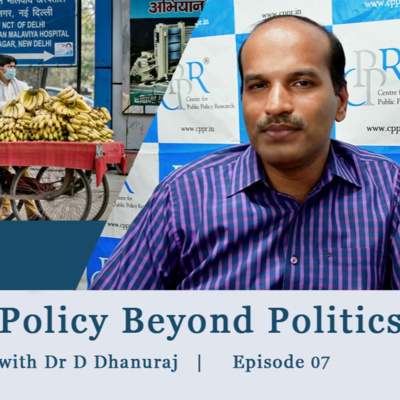
EP 07 Street Vendors and COVID-19 lockdowns | #PolicyBeyondPolitics
Recently Government launched PM Street Vendor’s Atmanirbhar Nidhi (PM #SVANidhi ) a special micro-credit scheme to provide loan of upto Rs 10,000 to #StreetVendors. At the same time, the lack of accommodating policies and guidelines to the street vendors have resulted in job loss and police brutality. In this episode of #PolicyBeyondPolitics , Dr D Dhanuraj (Chairman, #CPPRIndia) discuss with Pras

EP 06 Pacific Deterrence Initiative (PDI) and the US strategy in the Indo-Pacific | Policy Beyond Politics
US Secretary of State Mike Pompeo recently criticised the PLA for escalating the border tension with India and also militarising the South China Sea and illegally claiming more territory there threatening vital sea lanes. In this episode of #PolicyBeyondPolitics CPPR Chairman, Dr D Dhanuraj discusses with Dr Vijay Sakhuja, Distinguished Fellow of CPPR on the establishment of the Pacific Deterrence

EP 05 COVID Resetting the Politics and Money in Sports | Policy Beyond Politics
In this episode of #PolicyBeyondPolitics #CPPRIndia Chairman, Dr D Dhanuraj talks to Leslie Xavier, Senior Fellow (Sports Policies), CPPR and Editor (Sports), Newsclick.in on the impact of COVID on sports.
COVID has economically impacted athletes and various sporting events around the world, and also industries associated with sports . Indian Olympics Association has requested Sports Ministry for

EP 04 Indian Parliament going online | Policy Beyond Politics
It is time to leverage on our technological prowess and ensure the legislative business continues unhindered during the pandemic. In this episode of #PolicyBeyondPolitics, Dr D Dhanuraj (Chairman, CPPR) and Chakshu Roy, (Heads the outreach team and leads legislator and citizen engagement at PRS Legislative Research)explores the feasibility and legality of moving the Indian parliament sessions onli

EP 03 Rights & Responsibilities of Elected Representatives in changing situation like COVID | Policy Beyond Politics
In this part of Policy Beyond Politics, CPPR Chairman Dr D Dhanuraj and Dr Harisankar K. Sathyapalan, Research Fellow (International Law and Dispute Settlement), CPPR discuss the Rights and Responsibilities that need to be followed by Elected representatives in a pandemic lockdown situation.

EP 02 Trends and Projections of COVID19 in India: What to Expect in Coming Days | Policy Beyond Politics
In this part of Policy Beyond Politics video series CPPR Chairman Dr D Dhanuraj discuss with Senior Fellow of CPPR, Dr Rijo M John, on the Trends and Projections of the COVID-19 in India and what can we expect in the coming days.

EP 01 Alcoholnomics: Analysing Liquor Policies in India | Policy Beyond Politics
India's illiberal liquor policy oscillates between the two poles of moral stance of abstinence and the need for easy revenue. In the first episode of #Policybeyondpolitics Dr D D Dhanuraj (Chairman, CPPR) and Rahul V Kumar( Research Fellow), CPPR discuss issues around the liquor policy in the country.
Recommended
The Dhanya Varma Podcast - Malayalam Interviews

Make India Competitive Again

The Bollywood Radio

Heal Her Within™-Dil Se Baatein With Shalini

Indicast - All Podcasts

கதைகள் சூழ் உலகு - Kathaigal Soozh Ulagu

Psychovedas

Gumnam Saya – Horror Stories in Hindi

Chanakya Niti

Buddha's Stories: Self-Help, Mental Health and Psychology

Shiv Puran Katha in Hindi

Bollywood All Old Songs 70s 80s 90s
